A small bathroom does not have to feel cramped. The right LED mirror can make a 40-square-foot bathroom feel open, bright, and intentionally designed — without knocking down walls or adding windows.
The challenge is not finding an LED mirror that fits. It is finding one that makes the room feel larger while still providing enough reflection area to be useful. Too small, and the mirror becomes decorative rather than functional. Too large, and it overwhelms the space.
This guide walks you through mirror sizing, shape selection, and placement strategies for compact bathrooms in Indian homes — from studio apartments in Mumbai to 2BHK flats in Bangalore.
Why LED Mirrors Work Better in Small Bathrooms Than Traditional Mirrors
Traditional bathroom mirrors reflect available light but do not create it. In a small bathroom with limited natural light and a single overhead bulb, a standard mirror gives you a dim reflection and harsh shadows under the eyes and jaw.
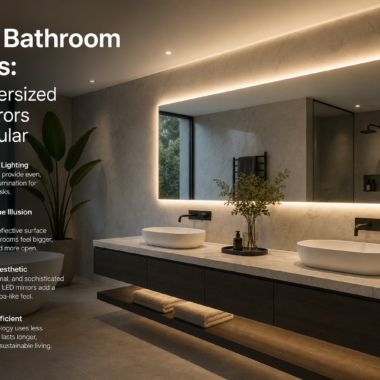
An LED mirror produces its own light from behind or around the glass. The illumination is even, shadow-free, and bright enough to see detail without secondary light sources. This makes the room feel more open because you are not relying on a ceiling fixture to light the space — the mirror itself becomes the primary light source.
In bathrooms under 50 square feet, an LED mirror typically replaces both the vanity mirror and the overhead light. This simplifies the electrical layout and reduces visual clutter — two fewer fixtures competing for attention in a tight space.
How to Measure Your Wall Space
Before you look at mirror styles, measure the wall where the mirror will hang. You need three measurements:
1. Available Width
Measure the width of the wall space from the left obstacle (usually the shower wall or bathroom door frame) to the right obstacle (typically a corner or a second door). Subtract 6 inches (15cm) from this measurement — that is the maximum mirror width you should consider.
Example: If your wall is 36 inches wide, your mirror should not exceed 30 inches wide. This leaves 3 inches of breathing room on each side, which prevents the mirror from looking wedged in.
2. Available Height
Measure from the top of your basin counter or vanity to the ceiling. Subtract 12 inches (30cm) from this measurement — that is the maximum mirror height.
Example: If you have 60 inches from counter to ceiling, your mirror should not exceed 48 inches tall. This leaves 4 inches clearance at the counter edge (to avoid splashes) and 8 inches at the ceiling (so the mirror does not crowd the ceiling line).
3. Basin Width
Measure the width of your basin or countertop. A well-proportioned mirror should be at least 70% of the basin width, but not more than 120%.
Example: If your basin is 24 inches wide, your mirror should be between 17 and 29 inches wide. A 20-inch mirror sits comfortably above a 24-inch basin. A 30-inch mirror looks oversized unless the basin is at least 25 inches wide.
Mirror Shapes and How They Affect Perceived Space
Rectangular Mirrors (Vertical Orientation)
A vertical rectangle makes the ceiling feel higher. This is the best shape for bathrooms with low ceilings (8 feet or less) or for narrow bathrooms where width is limited.
Recommended sizes for small bathrooms:
- 18″ × 24″ (450mm × 600mm) for single-basin setups in compact bathrooms
- 20″ × 28″ (500mm × 700mm) for slightly larger walls
- 24″ × 32″ (600mm × 800mm) if you have 36+ inches of wall width
Rectangular Mirrors (Horizontal Orientation)
A horizontal rectangle makes the room feel wider. This works well in bathrooms where the width is more constrained than the height — for example, a bathroom that is 4 feet wide but has a 9-foot ceiling.
Recommended sizes:
- 24″ × 18″ (600mm × 450mm) for compact wall spaces
- 30″ × 22″ (750mm × 550mm) for medium walls
- 36″ × 24″ (900mm × 600mm) if the wall permits
Round Mirrors
A round mirror softens the hard lines of a small bathroom — the tile grid, the vanity corners, the door frame. This creates a more relaxed, less boxy feeling.
Round mirrors work best when wall space is limited and you cannot fit a large rectangle without crowding the room. A 24-inch round mirror provides the same usable reflection area as a 20″ × 24″ rectangle, but the circular frame feels less imposing.
Recommended diameters for small bathrooms:
- 20″ (500mm) for very tight spaces
- 24″ (600mm) for most compact bathrooms
- 28″ (700mm) if the wall space allows
Oval Mirrors
An oval combines the height advantage of a vertical rectangle with the softer look of a round mirror. This is a good middle-ground option if you want vertical emphasis without the hard edges of a rectangle.
Recommended sizes:
- 18″ × 24″ oval for narrow walls
- 20″ × 28″ oval for medium spaces
- 24″ × 32″ oval for larger walls
Backlit vs. Frontlit: Which Works Better in Small Bathrooms?
Backlit LED Mirrors
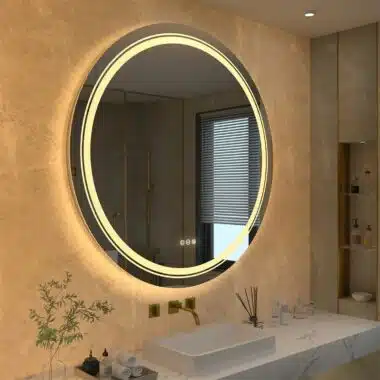
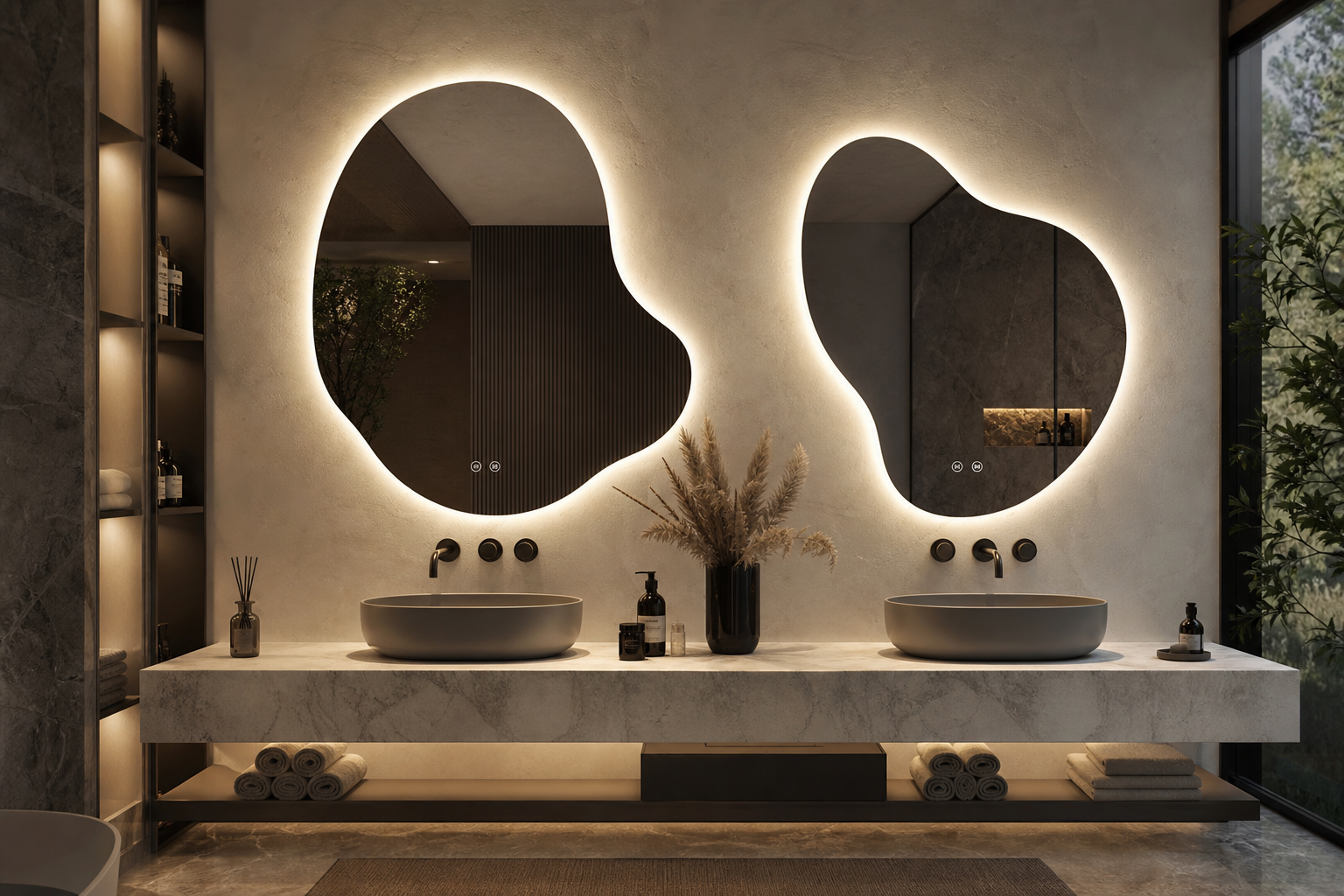
The LED strip sits behind the mirror glass and creates a soft glow around the mirror’s perimeter. This is called a halo effect. The light reflects off the wall and bounces back into the room, creating ambient illumination.
Backlit mirrors work well in small bathrooms because they make the wall behind the mirror feel deeper. The glowing outline creates a sense of layering — the wall, the light halo, the mirror glass — which adds visual depth to a flat surface.
Drawback: Backlit mirrors provide softer, more diffused light. If you need bright, task-focused lighting for close-up work (shaving, makeup, contact lenses), a backlit-only mirror may not be bright enough.
Frontlit LED Mirrors
The LED strip sits in front of the glass, pointing at your face. This creates direct, bright illumination with minimal shadows. The light is functional rather than decorative.
Frontlit mirrors work better in bathrooms where you need clear visibility for grooming. The light output is higher, and the color rendering is usually better (CRI 90+ on most frontlit models).
Drawback: Frontlit mirrors do not create the same sense of depth as backlit models. The light is utilitarian — it illuminates your face, but it does not make the room feel larger.
Hybrid: Backlit + Frontlit
Some LED mirrors combine both backlighting (for ambiance) and frontlighting (for task visibility). These mirrors have two separate circuits that you can control independently — turn on the backlight for a soft glow when you step into the bathroom at night, turn on the frontlight when you need full brightness.
Hybrid mirrors cost more (₹10,000-15,000 for mid-range models), but they are the most versatile option for small bathrooms where a single fixture has to serve multiple purposes.
Placement Tips for Maximum Space Perception
Center the Mirror Above the Basin
This is the default placement, and it works in 90% of small bathrooms. The mirror sits directly above the basin, centered on the vanity. The symmetry creates visual order, which makes the room feel calmer and more spacious.
Mount Slightly Higher Than Standard
Standard bathroom mirrors sit at 5 feet center height. In a small bathroom with an 8-foot ceiling, mounting the mirror at 5 feet 4 inches instead can make the ceiling feel taller. The extra 4 inches of vertical space draws the eye upward.
This works best with vertical rectangular mirrors or tall ovals. Do not mount so high that you lose the bottom of your reflection — the mirror’s bottom edge should still be 4-6 inches above the basin counter.
Use the Full Wall Width
If your bathroom has a single unbroken wall above the vanity, consider a mirror that spans 80-90% of the wall width. A wide mirror makes the wall feel expansive rather than fragmented. This is especially effective in narrow bathrooms (3.5 feet wide or less) where vertical space is tight.
Example: If your bathroom wall is 36 inches wide, a 32-inch horizontal mirror feels more spacious than a 24-inch mirror with 6 inches of empty wall on each side.
Avoid Multiple Small Mirrors
Two small mirrors side-by-side make a small bathroom feel busier rather than larger. A single, larger mirror creates a cleaner visual plane and reflects more light back into the room.
The exception: If you have a double-basin vanity in a small bathroom, two matching round mirrors can work if they are identical in size and symmetrically placed. But this is rare in truly compact bathrooms — most small bathrooms have a single basin.
Additional Features That Make Small Bathrooms Feel Larger
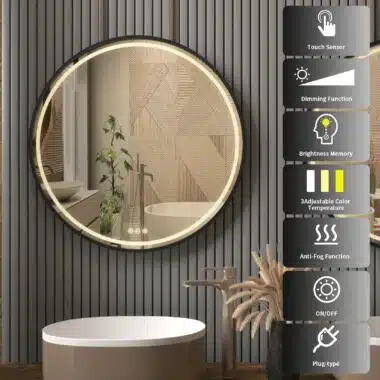
Anti-Fog Heating
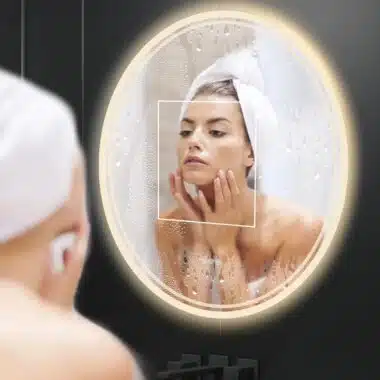
A fogged mirror after a hot shower makes a small bathroom feel even smaller — you lose the reflected light, and the room feels closed in. An anti-fog heater keeps the glass clear, which maintains the sense of openness.
This feature adds ₹1,500-3,000 to the mirror cost, but it is worth it in bathrooms with poor ventilation (common in older apartments and interior bathrooms without windows).
Dimmable LEDs
A dimmable LED mirror lets you adjust the light intensity based on the time of day. Full brightness in the morning when you need to see clearly, 30% brightness at night when you step in to brush your teeth.
Dimming capability also makes the bathroom feel more flexible — the same small room can shift from bright and task-focused to soft and relaxing, depending on your needs.
Frameless Design
A frameless mirror has no visible border — just glass and light. This makes the mirror feel like it is floating on the wall rather than mounted to it. The lack of a frame reduces visual clutter, which is valuable in small spaces where every element competes for attention.
Most LED mirrors sold in India are frameless by default. If you are comparing a framed mirror to a frameless one, choose frameless for small bathrooms.
Common Sizing Mistakes to Avoid
Choosing a Mirror Too Small for the Basin
A 16-inch mirror above a 30-inch vanity looks awkward — like a postage stamp on a table. The mirror should be at least 70% of the basin width. If your basin is 30 inches, your mirror should be at least 21 inches wide.
Ignoring the Ceiling Height
A 36-inch tall mirror looks proportional in a bathroom with a 10-foot ceiling, but it looks too tall in a bathroom with an 8-foot ceiling. The mirror should not reach closer than 12 inches to the ceiling, or it will feel like it is pushing against the ceiling line.
Choosing Shape for Style Over Function
A trendy hexagonal mirror might look good in an Instagram photo, but if it leaves you with only 60% usable reflection area compared to a same-sized rectangle, it is the wrong choice for a small bathroom where every inch of mirror surface counts.
Shape should follow function first, style second.
Recommended Mirror Sizes by Bathroom Footprint
Very Compact Bathrooms (30-40 sq ft)
Typical layout: Single basin, wall-mounted toilet, corner shower.
Recommended mirror size: 18″ × 24″ vertical rectangle or 20″ round
Small Bathrooms (40-55 sq ft)
Typical layout: Single basin on vanity, shower-tub combo, standard door clearance.
Recommended mirror size: 24″ × 30″ vertical rectangle or 24″ round
Medium-Small Bathrooms (55-70 sq ft)
Typical layout: Full vanity with storage, separate shower, window or exhaust fan.
Recommended mirror size: 30″ × 36″ vertical rectangle or 28″ round
Installation Considerations for Small Bathrooms
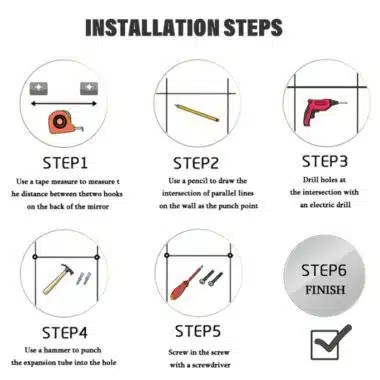
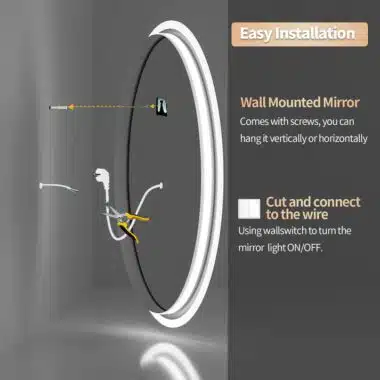
Small bathrooms often have limited wall stud support behind the tiles. If your bathroom wall is plasterboard (drywall) instead of solid brick or concrete, use toggle bolts instead of standard screws to mount the mirror. Toggle bolts spread the load across a wider area and prevent the mirror from pulling out of the wall over time.
For mirrors heavier than 10kg, add adhesive mirror tape to the back of the mirror frame (in addition to the mounting screws). This distributes weight and reduces stress on the mounting points.
How Lighting Temperature Affects Perceived Space
LED color temperature is measured in Kelvin (K). Small bathrooms feel more open under cool white light (5000K-6000K) compared to warm white light (3000K-4000K).
Cool white mimics daylight and makes the room feel brighter and more spacious. Warm white creates a cozy, intimate feeling, but it can make a small room feel even smaller — especially in bathrooms with dark tile or limited natural light.
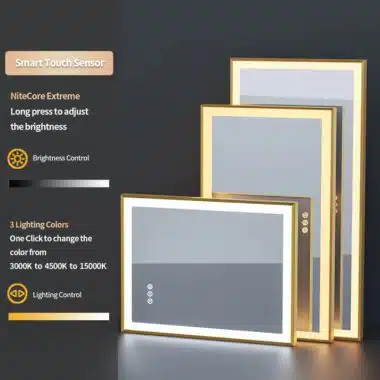
Most LED mirrors sold in India are fixed at 6000K (cool white) or offer a 3-in-1 switch between 3000K, 4500K, and 6000K. For small bathrooms, choose a mirror with adjustable temperature so you can test both and decide which makes your space feel better.
Final Thoughts: Proportion Over Size
In a small bathroom, the goal is not to find the largest mirror that fits. It is to find a mirror that is proportional to the basin, the wall, and the ceiling height — one that makes the room feel balanced rather than crowded.
A 24-inch mirror in the right shape and placement will make a 40-square-foot bathroom feel more spacious than a 36-inch mirror crammed into the same space.
Browse our LED mirror collection to find mirrors sized for compact Indian bathrooms, or contact us for sizing recommendations based on your wall dimensions.
Recommended Products
Based on this article, you might also like: